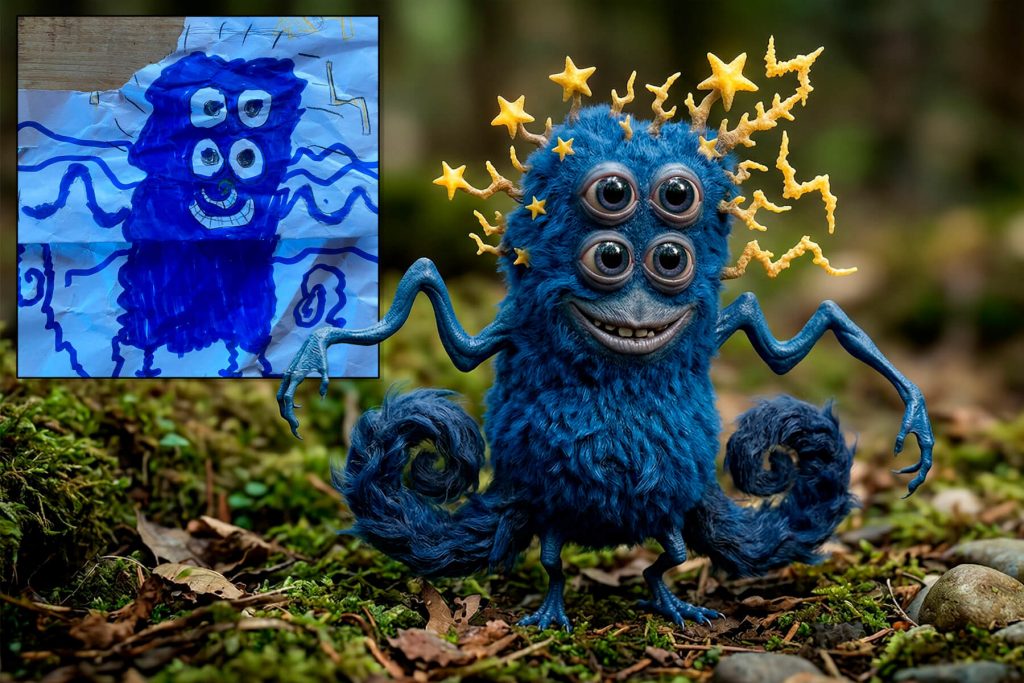
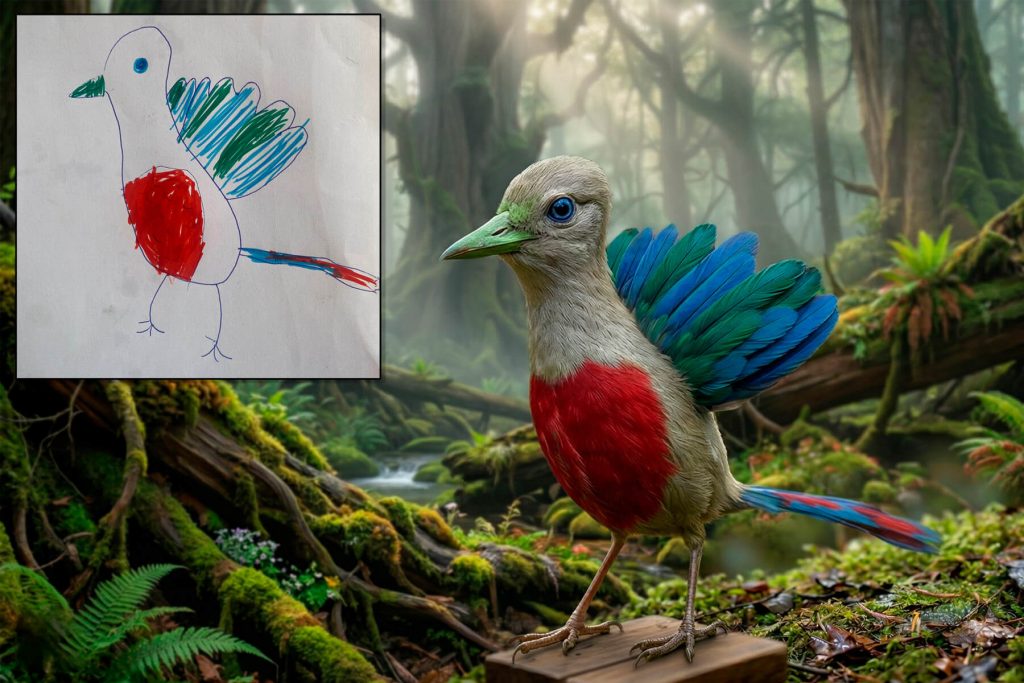
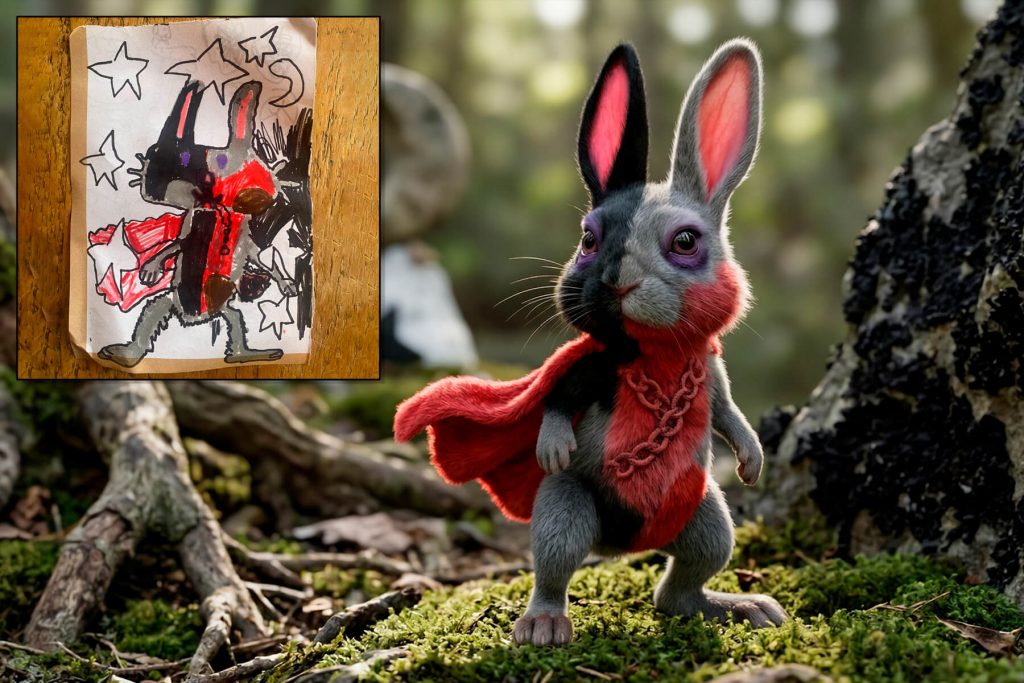
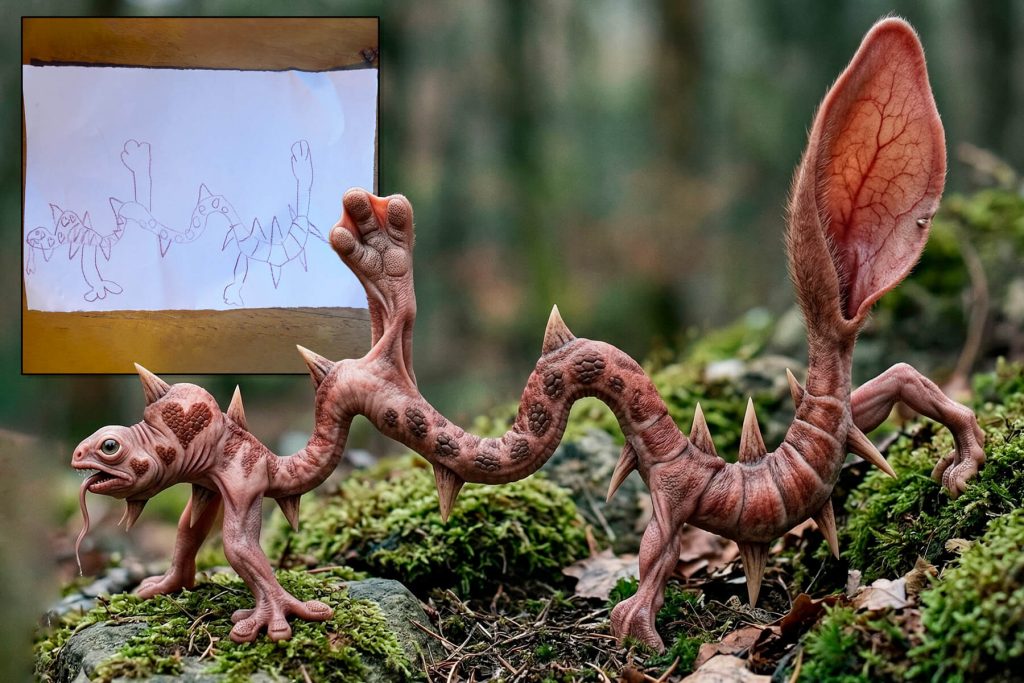
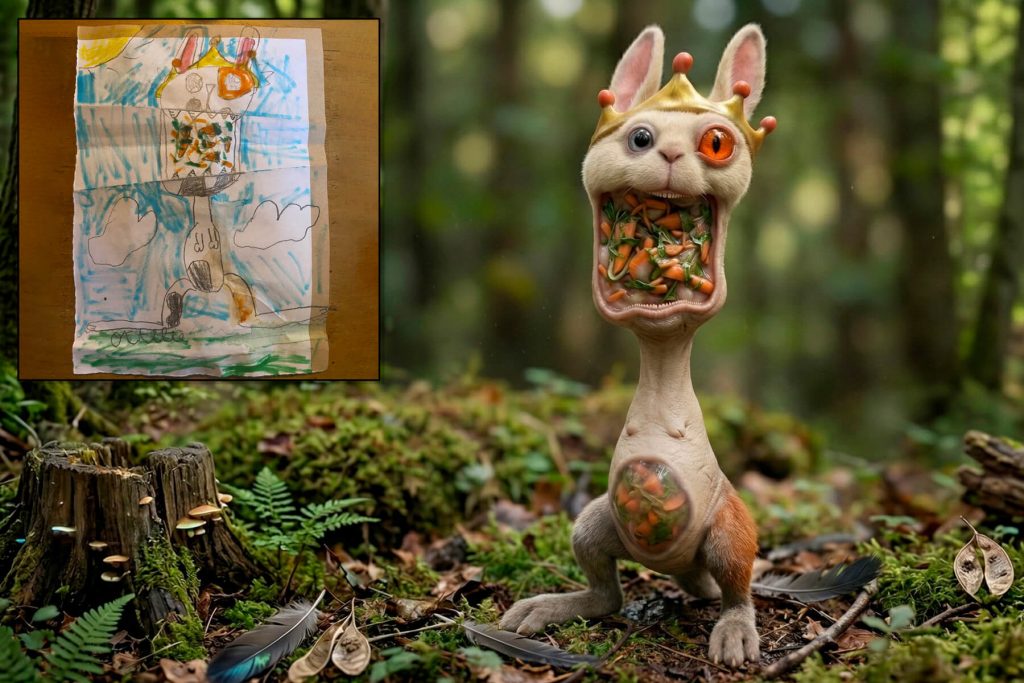
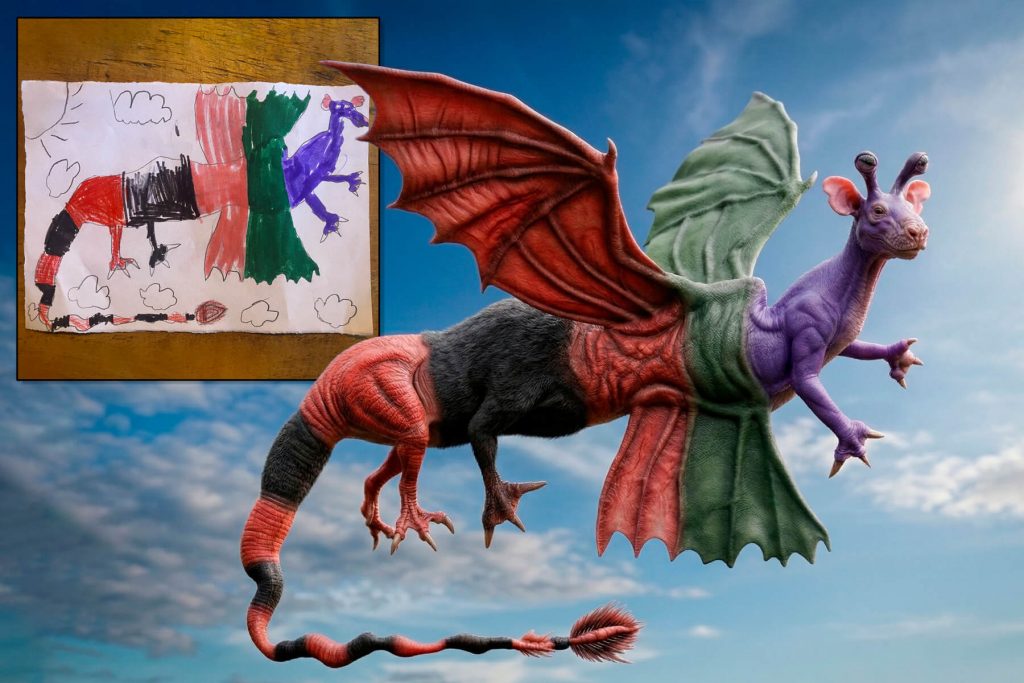
This project explored the dual nature of generative technology: its power as an incredible creative partner versus its role in disrupting the traditional design landscape.
For this initial challenge, I collaborated with my six-year-old daughter, Ottilie, to see if I could develop a sophisticated prompt capable of bridging the gap between a child’s imagination and professional-grade realism. The goal was to take her “wonky scribbles” and, rather than just cleaning them up, transform them into truly fantastical, realistic creatures.
As a designer of 20 years, I wanted to see if I could engineer a prompt that achieved a level of “magic” in seconds that would have traditionally taken me days of manual digital painting. The result was a successful proof of concept that allows parents to bring their children’s fledgling artwork to life with high-fidelity textures and lighting.
Try it yourself:
Turn this child’s drawing into a hyper-realistic 3D render or photorealistic image that looks like it exists in the real world.
Generate a high-fidelity wildlife photograph of a living organism, using the provided sketch as a definitive anatomical blueprint. The objective is to manifest a biological entity that adheres strictly to the drawing’s original silhouette, proportions, and asymmetrical features while introducing realistic textures and materials.
Environment & Context
Setting: Place the creature in a believable, fully rendered natural habitat appropriate for its anatomy, such as mossy ground, a detailed forest floor, or textured rocks.
Composition: The creature must be a physical, three-dimensional being interacting naturally with this environment, completely removing any impression of it being a flat illustration on paper.
Anatomical Mapping
Structural Integrity: Retain the exact geometry and placement of all features. Every flat shape should gain three-dimensional volume without altering its established outline.
Feature Conversion: Eyes: Interpret simple circles as moist, organic ocular organs, maintaining their original scale and position.
Mouth: Translate linear strokes into natural oral apertures or skin folds.
Limbs: Convert stick-like appendages into plausible, lean biological structures that follow the existing skeletal paths.
Surface & Material Realism
Texture: Apply authentic biological surfaces such as short pelage or fine epidermal grain, including subtle creases and organic imperfections.
Coloration: Map the sketch’s palette directly onto the creature’s hide. Use tonal shifts derived from the drawing’s shading rather than introducing external patterns.
Lighting: Utilize soft, natural light with realistic eye glints and high-frequency textural detail.
Photographic Execution
Aesthetic: The image should evoke the feeling of a serious nature documentary capturing a rare, perhaps evolutionarily peculiar, specimen.
Camera Settings: 85mm focal length, shallow depth of field, and a minimalist natural backdrop to ensure the subject is the primary focus.
Final Criterion
The biological result must be so faithful to the source material that the creature’s form could be perfectly overlaid onto the original sketch. It should appear as a “real” version of the drawing, embracing any inherent awkwardness as a legitimate trait of the species.
Description
Personal
April 2026
Engineering advanced prompts to transform children’s sketches into high-fidelity realistic creatures as part of a series exploring the intersection of AI and traditional design.